Top Tourist Attractions in Bishnupur
“Bishnupur – Heritage in Every Brick, Music in Every Heart.”
History of Bishnupur – The Terracotta Town of Bengal
Bishnupur, located in Bankura district of West Bengal, is a town celebrated for its terracotta temples, classical music, and traditional crafts. Its history dates back to the 7th century, when it rose to prominence as the capital of the Malla dynasty. The Malla rulers, especially during the 16th to 18th centuries, were great patrons of art, culture, and religion.
Apart from its temples, Bishnupur is also known as the birthplace of the world-renowned Bishnupur Gharana of Hindustani classical music and its unique Baluchari silk sarees, woven with mythological motifs. The town’s heritage combines spirituality, music, and craftsmanship, making it a must-visit destination for history lovers and culture seekers.
Today, Bishnupur is celebrated as the City of Temples and Music, attracting tourists from across the globe to explore its timeless traditions and living history.
Ma Mrinmoyee Temple
Ma Mrinmoyee, the presiding deity of Bishnupur, holds a revered place in Bengal’s religious and cultural history. The temple, established in 997 AD by Malla King Jagat Malla, stands as a testament to the deep devotion of the Malla kings. As per legend, the king received a divine command from Goddess Durga in a dream to relocate his capital to Bishnupur, and shortly after, he consecrated the Mrinmoyee Temple near the royal palace.
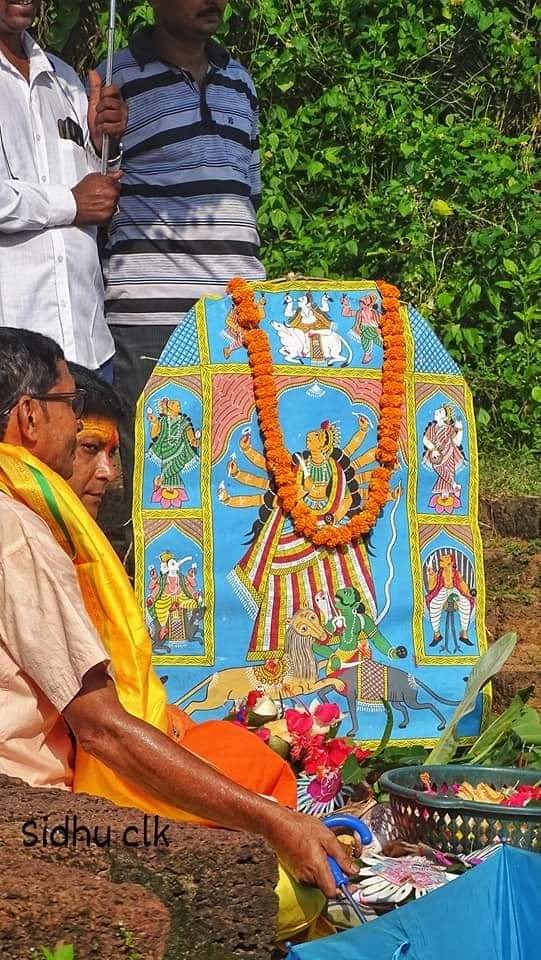
The name “Mrinmoyee” means “made of clay,” and the goddess’s idol is sculpted from Ganges clay, symbolizing the simplicity and purity of rural Bengal. The temple is also home to Bengal’s oldest Durga Puja, following the ancient Ballinarayani tradition. Unlike the mainstream Durga Pujas, Ma Mrinmoyee’s puja doesn’t involve the immersion of the idol. Instead, each year, a clay pot is established, and the goddess is worshipped as a painted image.
The rituals begin with the Bodhan ceremony, where a silver Mahishasuramardini idol, believed to be Ma Mrinmoyee herself, is bathed with the Nabapatrika in Krishnabandh pond, marking the start of the festivities. Today, the Ma Mrinmoyee Temple remains a center of spiritual heritage, embodying centuries of tradition, devotion, and cultural richness in Bishnupur.
The Jor-Bangla Temple
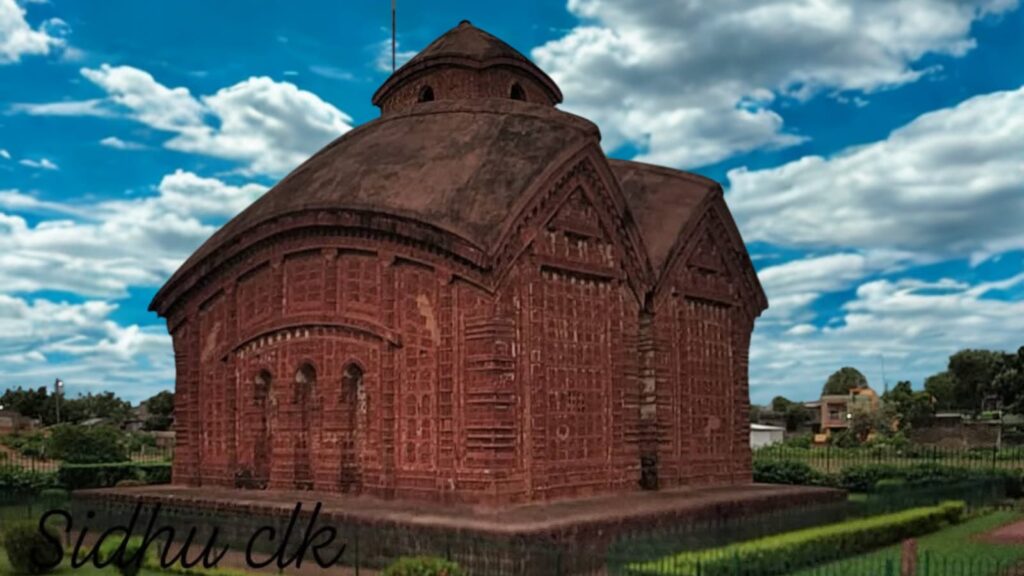
The Jor-Bangla Temple, also known as Keshta Rai Temple, is a fine example of traditional architecture commonly found in southern Bengal. It was constructed by Malla King Raghunath Singha around 1655. The temple’s design resembles two traditional ‘do-chala’ village huts placed side by side. The front structure serves as a porch, while the rear structure functions as a shrine. The roof is curved, and the pair of huts is topped by a ‘char-chala shikhara’ (a four-sided spire).
The temple stands on a square base measuring 11.8m x 11.48m, with a height of 10.7m above the platform. Its walls are adorned with intricately detailed terracotta panels depicting scenes from the Ramayana and Mahabharata, along with floral and geometric patterns. The craftsmanship is so elaborate that it visually narrates entire stories from these epics.
RASMANCHA
The Architectural and Cultural Gem of Bishnupur
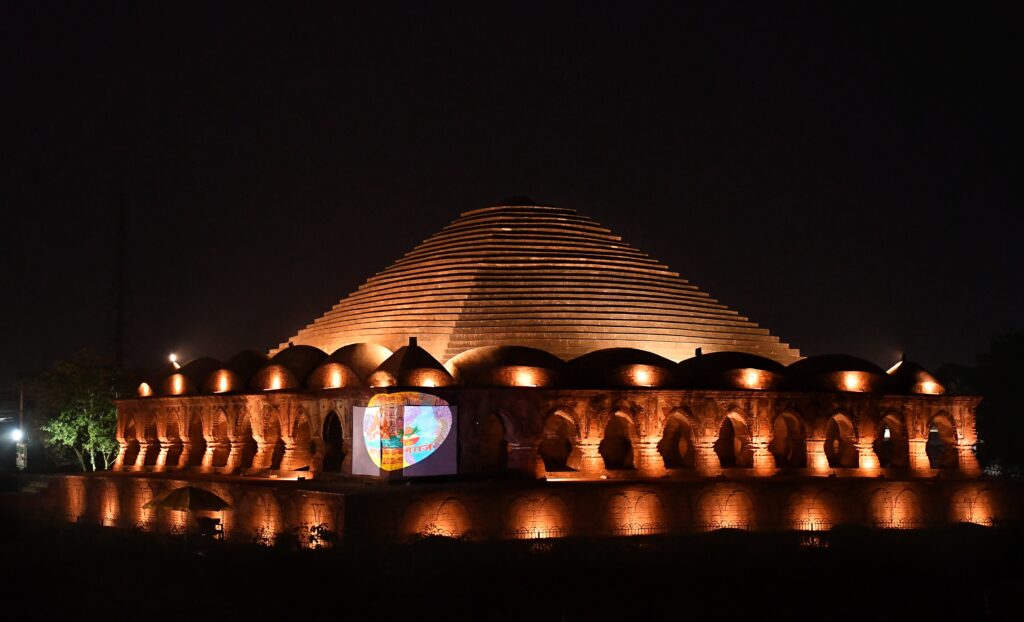
Among the many historical marvels of Bishnupur, the Rasmancha stands as one of the most iconic and revered monuments, drawing countless visitors every year. Built around 1600 AD by the Mallabhum ruler King Hambir Malla Dev, also known as Bir Hambir, this structure is not only an architectural wonder but also a site of immense cultural and religious significance.
Historically, the Rasmancha served as the central venue for the Vaishnava Ras festival, a grand celebration of devotion and art in Bishnupur. During this annual event, which continued until 1932, idols of Radha and Krishna from all temples across the town were ceremoniously brought to the Rasmancha. Here, devotees gathered in large numbers to offer prayers and witness the divine celebration.
Architecturally, the Rasmancha is unlike any other temple in Bishnupur. It stands on a square laterite platform measuring 24.5 meters by 24.5 meters and elevated 1.5 meters above ground level. Above this, a brick superstructure rises to a height of 12.5 meters, crowned by a pyramidal roof surrounded by structures in the traditional ‘chala’ style. The roof is supported by a network of 40 intricately carved pillars and arches, adorned with motifs of floral patterns and human figures, reflecting the artistic brilliance of the era.
The sanctum within is surrounded by three concentric circumambulatory galleries, allowing devotees to move around in prayer. Atop the inner chamber sits a massive pyramidal crown, reminiscent of a Buddhist stupa, lending the Rasmancha its distinctive silhouette and spiritual aura.
Today, the Rasmancha stands not only as a testament to the architectural innovation of the Malla dynasty but also as a symbol of Bishnupur’s deep-rooted devotion and rich cultural heritage.